
A Quick Overview
If you've ever checked the ingredients on a yogurt, candy, juice, or cosmetic product, you may have noticed Carmine or E120 listed on the label. Many Muslim consumers wonder whether this ingredient is halal because it comes from insects rather than plants or minerals.
Understanding what Carmine is, where it comes from, and how different halal certification bodies evaluate it can help you make informed decisions when shopping.
What Is Carmine (E120)?
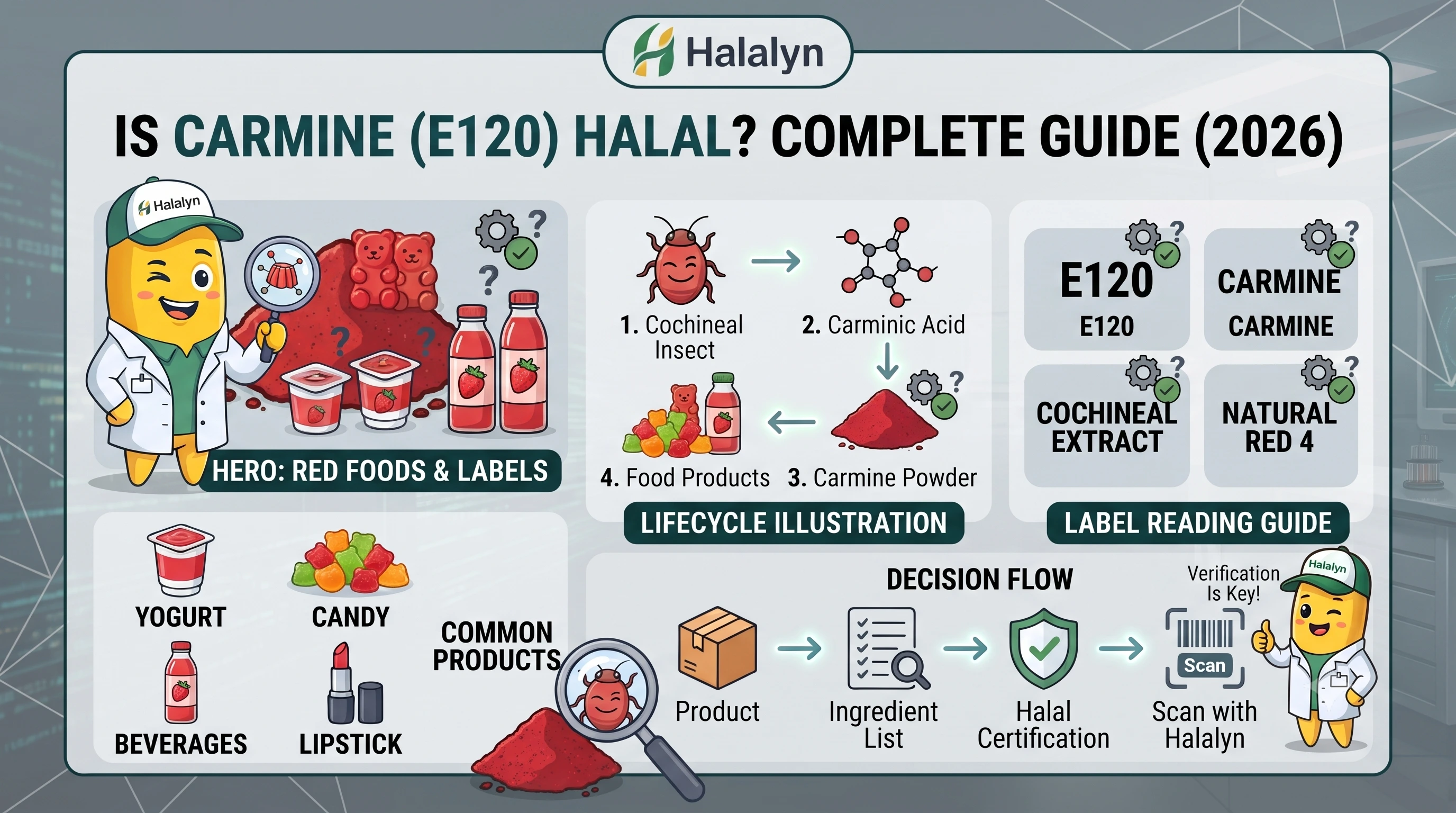
Carmine, also known as E120, Cochineal Extract, Natural Red 4, or Crimson Lake, is a natural red colouring extracted from female cochineal insects.
Unlike artificial food dyes, Carmine is valued because it produces a bright, stable red colour that remains vibrant even after heating or long storage.
Manufacturers use it in food, beverages, cosmetics, and some pharmaceutical products.
Where Does Carmine Come From?
Carmine is produced from tiny insects called cochineal insects, which live mainly on prickly pear cactus plants in countries such as Peru, Mexico, and parts of South America.
After harvesting, the insects are dried and processed to extract carminic acid, the natural pigment responsible for the deep red colour. This pigment is then purified and used as a colouring ingredient in many commercial products.
Why Is Carmine Used in Food?
Food manufacturers choose Carmine because it offers several advantages:
- Produces a vibrant natural red colour.
- More stable than many plant-based colourings.
- Resistant to heat and light.
- Maintains colour during long shelf life.
- Considered a natural alternative to some synthetic food dyes.
Because of these properties, Carmine appears in many processed foods around the world.
Is Carmine (E120) Halal?
The answer is not always straightforward.
Since Carmine is derived from insects, different Islamic scholars and halal certification organisations may reach different conclusions depending on their interpretation of Islamic dietary principles and the manufacturing process.
Some halal certification bodies consider Carmine permissible under specific conditions, while others avoid certifying products containing insect-derived ingredients.
For this reason, consumers should avoid assuming that every product containing E120 is automatically halal or automatically haram.
Instead, consider:
- Whether the product carries a trusted halal certification.
- The guidance of your preferred scholar or halal authority.
- The manufacturer's ingredient information when certification is unavailable.
Gelatin is another commonly misunderstood ingredient. Read our complete guide on what makes gelatin halal or haram.
Why Do Scholars Differ?
The discussion generally focuses on questions such as the following:
- Whether insects are considered permissible for consumption.
- Whether the manufacturing process changes the original substance.
- Whether the colouring functions only as a processed ingredient or remains insect-derived.
These differences explain why opinions can vary between scholars and certification organisations.
When uncertainty exists, many Muslims choose certified halal alternatives for peace of mind.
Foods That May Contain Carmine
Carmine may appear in products such as the following:
- Yogurt
- Ice cream
- Candy
- Gummies
- Fruit drinks
- Soft drinks
- Cakes
- Frosting
- Breakfast cereals
- Flavoured milk
- Processed desserts
- Cosmetic products
- Lipstick
- Some medicines and supplements
Not every product in these categories contains Carmine, so always read the ingredient label.
Other Names for Carmine
Manufacturers may list Carmine under different names, including:
- E120
- Carmine
- Cochineal
- Cochineal Extract
- Carminic Acid
- Natural Red 4
- Crimson Lake
Recognising these alternative names can help you identify the ingredient more easily.
Halal Alternatives to Carmine
Many manufacturers now use plant-based alternatives, including the following:
- Beetroot extract
- Red cabbage extract
- Paprika extract
- Anthocyanins
- Lycopene
Products using these colourings may be suitable alternatives, although the overall halal status still depends on all ingredients in the product.
How to Check Products More Easily
Reading ingredient labels can be time-consuming, especially when unfamiliar ingredient names appear.
Instead of searching every ingredient individually, you can scan product barcodes with Halalyn to receive ingredient information and halal guidance before making a purchase.
Frequently Asked Questions
Is E120 the same as Carmine?
Yes. E120 is the European food additive number for Carmine.
Is Carmine a natural ingredient?
Yes. Carmine is a natural colouring extracted from cochineal insects.
Does every product containing E120 have the same halal status?
No. Halal status depends on the ingredient source, manufacturing process, certification, and the standards of the halal authority evaluating the product.
Is Carmine used only in food?
No. Carmine is also used in cosmetics, pharmaceuticals, and personal care products.
Can I identify Carmine from the product colour alone?
No. Many red products use different colourings. Always read the ingredient list or check for halal certification.
Conclusion
Carmine (E120) is a widely used natural red colouring made from cochineal insects. Because it is insect-derived, its halal status is discussed differently by various scholars and halal certification organisations.
Rather than relying on assumptions, the safest approach is to check ingredient labels, look for trusted halal certification, and consult reliable scholarly guidance when needed.
Understanding ingredients like Carmine helps you make more informed food choices and shop with greater confidence.
Unsure About an Ingredient?
Instead of searching for each ingredient individually, scan the product with Halalyn to instantly understand what each ingredient means before you buy.
✓ Ingredient explanations
✓ E-number lookup
✓ Halal guidance
✓ Smart barcode scanner
Editorial & Research Board
Official Halalyn food science, ingredient analysis, and dietary policy editorial team.