
Introduction
Many packaged foods contain ingredients that look harmless at first glance, but some can originate from animal, insect, or other sources that require additional verification. Understanding these ingredients is an important part of making informed halal food choices.
Whether you're shopping for snacks, dairy products, baked goods, or processed meals, reading ingredient labels can quickly become confusing. Names like Gelatin, E471, or Natural Flavors rarely tell the whole story, making it difficult to determine whether a product aligns with your dietary requirements.
Halalyn helps simplify this process by allowing you to scan food products, identify potentially sensitive ingredients, and learn more about their origin through clear educational explanations. Instead of guessing, you can make more informed decisions based on ingredient transparency.
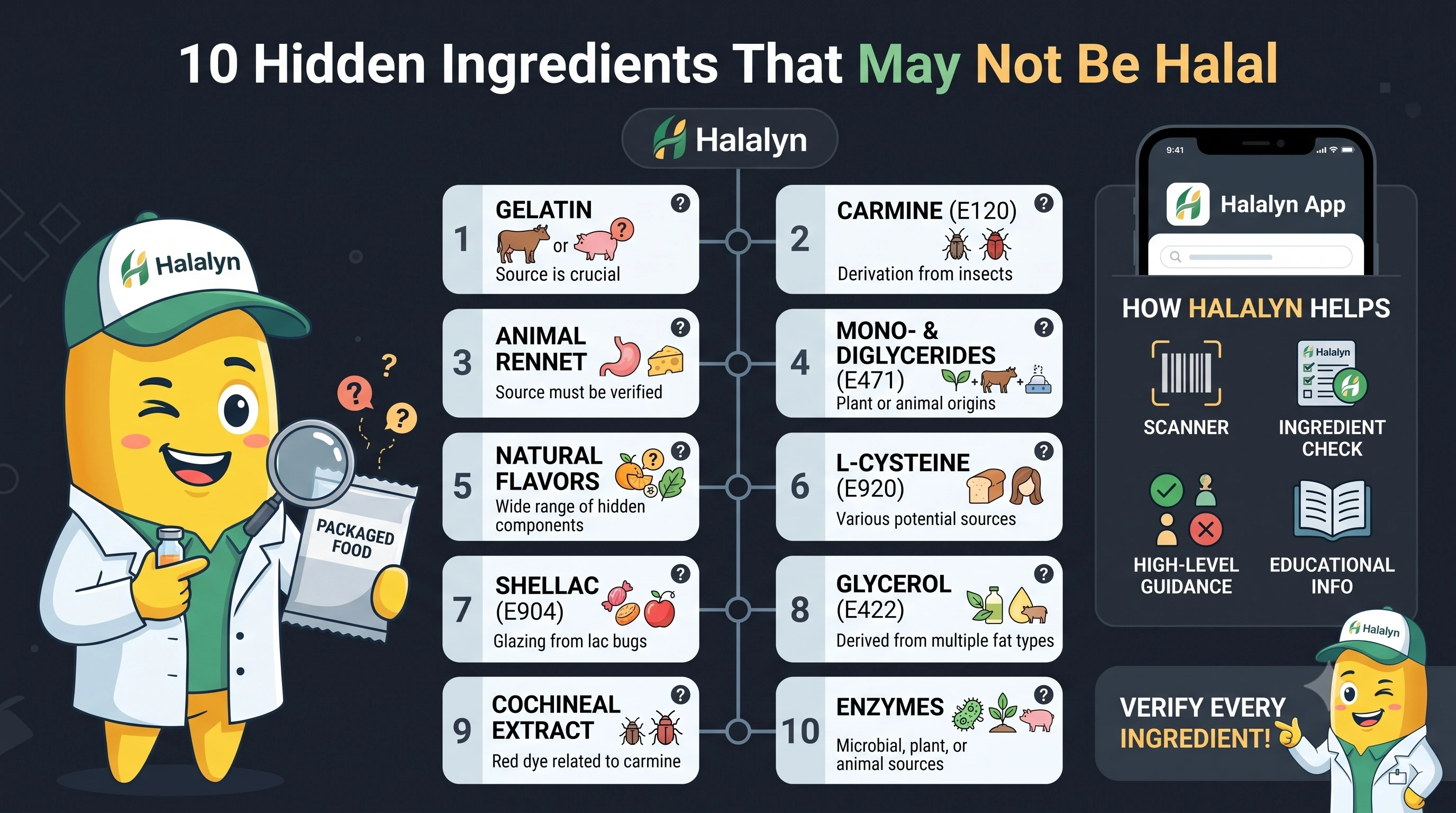
1. Gelatin
Gelatin is one of the most commonly questioned ingredients in halal food. It is widely used in gummies, marshmallows, yogurt, desserts, capsules, and many processed foods because it provides texture and stability.
The halal status of gelatin depends primarily on its source. Gelatin produced from halal-certified bovine (beef) or fish sources is generally considered permissible. However, gelatin derived from pork (porcine) is not considered halal, whereas gelatin from cattle requires verification that the animal was slaughtered in accordance with Islamic requirements.
Because many food labels list "gelatin" without identifying its origin, consumers often cannot determine its halal status from the packaging alone. This is why checking the manufacturer or using trusted ingredient verification tools becomes important.
Tip: If the label simply says "Gelatin" without specifying the source, treat it as an ingredient that requires further verification rather than making assumptions.
Before purchasing products containing gelatin, check:
- Whether the manufacturer specifies the gelatin source.
- Whether a recognized halal certification is displayed.
- Whether the product has been verified using Halalyn.
2. Carmine (E120)
Carmine is a natural red food coloring obtained from cochineal insects. It is commonly used to give products a vibrant red or pink color and can be found in candies, yogurts, beverages, desserts, cosmetics, and some processed foods.
On ingredient labels, Carmine may also appear as Cochineal, Cochineal Extract, or the food additive code E120. Because it is derived from insects, many halal-conscious consumers prefer to verify its suitability before consuming products that contain it.
While Carmine is approved for use as a food coloring in many countries, its halal status may depend on the interpretation followed by different halal certification bodies. When the ingredient source or certification is unclear, it is always best to verify the product rather than relying solely on the ingredient name.
Remember: An ingredient being legally approved for food use does not automatically determine whether it meets halal dietary requirements.
How to check products containing Carmine
- Look for Carmine, Cochineal, or E120 on the ingredient label.
- Check whether the product carries a trusted halal certification.
- If the source is unclear, scan the product with Halalyn to learn more about the ingredient.
European Commission Food Additives Database can help to find the ingredients' sources.
3. Animal Rennet
Animal rennet is an enzyme traditionally used in cheese production to coagulate milk. It is naturally extracted from the stomach lining of young calves and has been used for centuries in the production of many traditional cheeses.
The halal status of animal rennet depends on both the animal source and the slaughter method. Rennet obtained from animals slaughtered according to Islamic requirements is generally considered permissible. However, rennet sourced from non-halal slaughtered cattle or from pigs is not considered halal.
Many cheese labels simply state "rennet" without specifying whether it is animal, microbial, or plant-based. Because of this lack of transparency, consumers may need additional verification before making a purchasing decision.
Tip: If the ingredient list only mentions "rennet" without identifying its source, consider it an ingredient that requires further verification.
Common alternatives to animal rennet
Today, many manufacturers use microbial or fermentation-produced rennet instead of animal-derived rennet. These alternatives are often suitable for vegetarian products and may also simplify halal verification, although certification should still be checked whenever possible.
- Animal rennet (requires source verification)
- Microbial rennet (commonly used)
- Fermentation-produced chymosin (widely used in modern cheese production)
- Plant-based rennet (used in some specialty cheeses)
How to verify cheese products
- Read the ingredient list carefully.
- Identify whether the label specifies animal, microbial, or vegetarian rennet.
- Look for a trusted halal certification.
- When the source is unclear, use Halalyn to learn more about the ingredient before purchasing.
4. Mono- and Diglycerides (E471)
Mono- and diglycerides (E471) are emulsifiers commonly used to improve the texture, consistency, and shelf life of processed foods. They are frequently found in bread, cakes, margarine, chocolate, ice cream, peanut butter, and many packaged snacks.
The halal status of E471 depends entirely on its source. It can be produced from vegetable oils, which are generally considered halal, or from animal fats. If animal fats are used, the ingredient is only considered halal when the source animal was slaughtered according to Islamic requirements.
Most food labels simply list "Mono- and Diglycerides (E471)" without identifying whether the ingredient comes from plant or animal sources. This makes it difficult for consumers to determine its halal status based on the packaging alone.
Tip: E471 is not automatically halal or haram. Always verify its source whenever the manufacturer does not provide additional information.
Products that commonly contain E471
- Bread and bakery products
- Cakes and pastries
- Chocolate and confectionery
- Ice cream
- Margarine and spreads
- Processed snacks
How to verify products containing E471
- Check whether the manufacturer states that E471 is plant-based.
- Look for a trusted halal certification.
- Contact the manufacturer if the ingredient source is unclear.
- Scan the product with Halalyn for ingredient guidance before purchasing.
5. Natural Flavors
"Natural flavors" is a broad term that can include ingredients from plants, animals, or microbial sources. Because manufacturers are not required to disclose the exact source, it is often difficult to determine whether a product is halal based on the label alone.
When natural flavors are listed without further explanation, look for halal certification or contact the manufacturer for clarification.
- Check for halal certification.
- Contact the manufacturer if necessary.
- Use Halalyn to verify ingredients before purchasing.
6. L-Cysteine (E920)
L-Cysteine (E920) is a dough conditioner commonly used in bread, pizza dough, pastries, and other baked goods. It helps improve dough elasticity and reduces processing time during manufacturing.
The halal status of L-Cysteine depends on its source. It may be produced from synthetic or microbial fermentation methods, which are generally acceptable, or from animal or human-derived materials, which require careful verification.
Choose products with trusted halal certification whenever L-Cysteine (E920) is listed and the ingredient source is not specified.
- Check whether E920 is fermentation-derived.
- Look for halal certification.
- Use Halalyn to verify the ingredient before purchasing.
7. Shellac (E904)
Shellac (E904) is a glazing agent commonly used to give candies, chocolates, chewing gum, coffee beans, and some fruits a shiny appearance. It is produced from the secretions of the lac insect.
Because Shellac is insect-derived, its halal status may vary according to different scholarly opinions. If you are unsure, look for halal certification or choose products that clearly state the source of their glazing agents.
If a product lists E904 or Shellac without further information, verify it before purchasing if you follow a stricter halal standard.
- Check for halal certification.
- Look for E904 or Shellac on the ingredient list.
- Use Halalyn to verify the ingredient before purchasing.
8. Glycerol (E422)
Glycerol (E422) is a sweetener and moisture-retaining ingredient commonly found in chewing gum, candies, baked goods, protein bars, and pharmaceutical products. It can be produced from either vegetable oils or animal fats.
Its halal status depends on its source. Vegetable-derived glycerol is generally considered halal, while animal-derived glycerol requires verification to ensure it comes from halal-slaughtered animals.
When the source of glycerol is not disclosed, look for halal certification or contact the manufacturer for clarification.
- Verify whether the glycerol is plant-based.
- Look for halal certification.
- Use Halalyn when the source is unclear.
9. Cochineal Extract
Cochineal Extract is a natural red food coloring obtained from cochineal insects. It is closely related to Carmine (E120) and is commonly used in beverages, confectionery, dairy products, and processed foods.
Since Cochineal Extract is insect-derived, its halal status may differ according to scholarly opinions. Consumers who follow stricter halal standards should verify products containing this ingredient before purchasing.
Look for halal certification whenever Cochineal Extract or Carmine is listed on the ingredient label.
10. Enzymes
Enzymes are widely used during food production to improve texture, flavour, and processing efficiency. They may originate from microbial, plant, or animal sources, but food labels rarely specify their origin.
Because the source is often unknown, halal-conscious consumers should verify products containing unspecified enzymes, especially in cheese, baked goods, and processed foods.
- Look for halal certification.
- Contact the manufacturer if necessary.
- Verify uncertain ingredients using Halalyn.
How Halalyn Helps
Understanding ingredient labels can be challenging, especially when manufacturers do not disclose the source of an ingredient. Halalyn simplifies this process by helping you identify potentially sensitive ingredients, recognize E-numbers, and access educational explanations based on reliable ingredient information.
- Scan food products in seconds.
- Identify potentially sensitive ingredients.
- Learn what each ingredient means.
- Make more informed halal purchasing decisions.
Final Thoughts
Ingredient names alone do not always reveal whether a product is halal or haram. Many ingredients depend on their source, manufacturing process, or certification rather than their name.
Instead of making assumptions, always read ingredient labels carefully, look for trusted halal certification, and verify uncertain ingredients before purchasing. Small checks today can help you make more confident halal food choices every day.
Whenever you're unsure about an ingredient, scan the product with Halalyn to quickly identify potentially sensitive ingredients, understand their origin, and make more informed halal purchasing decisions.
Editorial & Research Board
Official Halalyn food science, ingredient analysis, and dietary policy editorial team.